
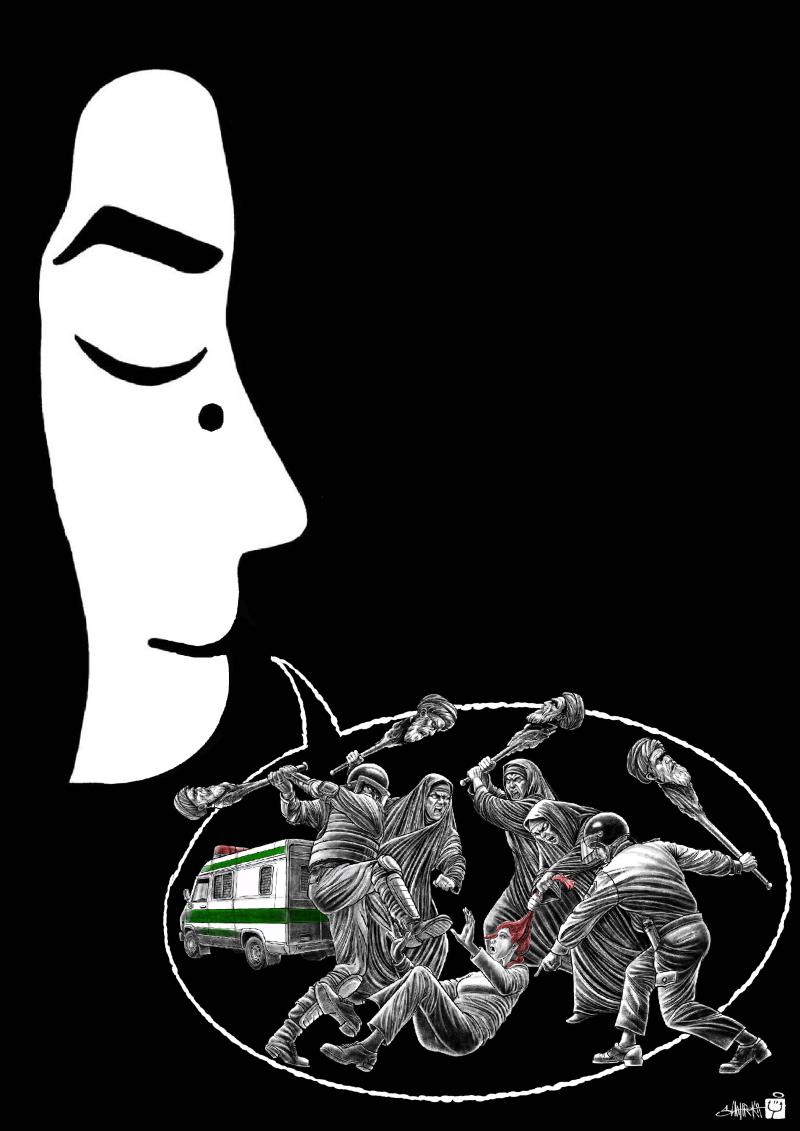

Marjane Satrapi
Exile, and the leaving of one’s homeland, does not always begin at the airport. Sometimes it begins much earlier: in a street full of fear, in the loudspeaker of a mosque tearing through one’s sleep, in a childhood forced too soon to face war and repression, or in the cigarette smoke of a taxi driver blown, without permission, into your private space. Sometimes a person has been driven out for years before actually leaving.
Inside the suitcase and bundle of an exiled artist, papers, pencils, unfinished sketches, unfinished dreams, griefs, memories, longings, fears, wounds, the image of streets they will no longer see, and the voices of people left behind, all travel with them. These are pains that are written on no airport form, beside height, eye color, or passport number. They pass silently through security gates, carry no weight on the airport scale, yet remain heavy in the mind for years, and sometimes, without warning, begin to wail.
Then a new life begins: a new language, new work, unfamiliar streets, new people, new loves, devastating separations, and another culture that slowly opens its door and makes room for you. The migrant learns to live again, to build again, to move forward again. But that hidden burden remains somewhere inside; sometimes silent, sometimes seemingly distant, but never gone.
Marjane Satrapi had brought the memories of her childhood with her: home, family, revolution, repression, war, exile, fear, and the bitter humor of a time she had lived through. These things stayed inside her for years, until at last, one by one, they emerged from the bundle of memory and settled onto paper in a language that was simple, minimal, and familiar, beneath light, stain, and the black-and-white contrast of her line.
Perhaps the blackness and simplicity of those lines in her work were not merely a graphic choice. For those of us who know those years, they carried something of the murkiness of Iran in the 1980s: the closed-in streets, the everyday fears, the monochrome sky and earth, the shadow of the Islamic Revolutionary Committees, that muddy olive green which was not only the color of clothing, but the mood of an entire era. In her simple lines, in that unadorned black and white, one suddenly found a part of one’s own experience: the experience of leaving, of being left behind, of rebuilding, and of returning to a wound one thought one had passed through years before. But that wound was still defiantly alive, asserting itself in the mirror within us.
Marjane died in Paris.
But the burden she had carried from Iran remained on paper; the same burden no border had been able to stop.
In memory of Marjane Satrapi;
the woman who opened her suitcase
and drew the things that could not be said in words.
- Use in a business presentation.
- Use in the classroom.
- Use on personal website/blog.
- Use on non-profit website/newsletter.
- All licenses include the right to publish on social media channels.
- Free custom video slideshow when you purchase four cartoons or more.
Can't find the license you need or do have questions? Check our FAQ or contact us.



0 Comments